
American Skullcap: A Trefoil Gardens Herbal Monograph
American Skullcap
Scutellaria lateriflora 🌿
A Trefoil Gardens Herbal Monograph
American Skullcap is Quiet. Unassuming. A little wild around the edges.
If you aren't looking closely, you might walk right past it.
But spend some time with American skullcap (Scutellaria lateriflora) and you begin to understand why herbalists have kept company with this little plant for generations.
At Trefoil Gardens, skullcap has become one of our favorite herbs for preparations intended to invite a little more quiet into the day. We grow it ourselves here in our Georgia gardens, harvest the aerial parts while the plant is flowering, and work with it in teas, tinctures, and botanical blends.
It's a plant we think about when everything feels just a little too loud.
Too much light.
Too much noise.
Too much thinking.
Too much everything.
This is our introduction to the quiet little plant we know as American skullcap.
Meet American Skullcap
Botanical name: Scutellaria lateriflora L.
Family: Lamiaceae (the mint family)
Common names: American skullcap, blue skullcap, Virginian skullcap, mad-dog skullcap, hoodwort
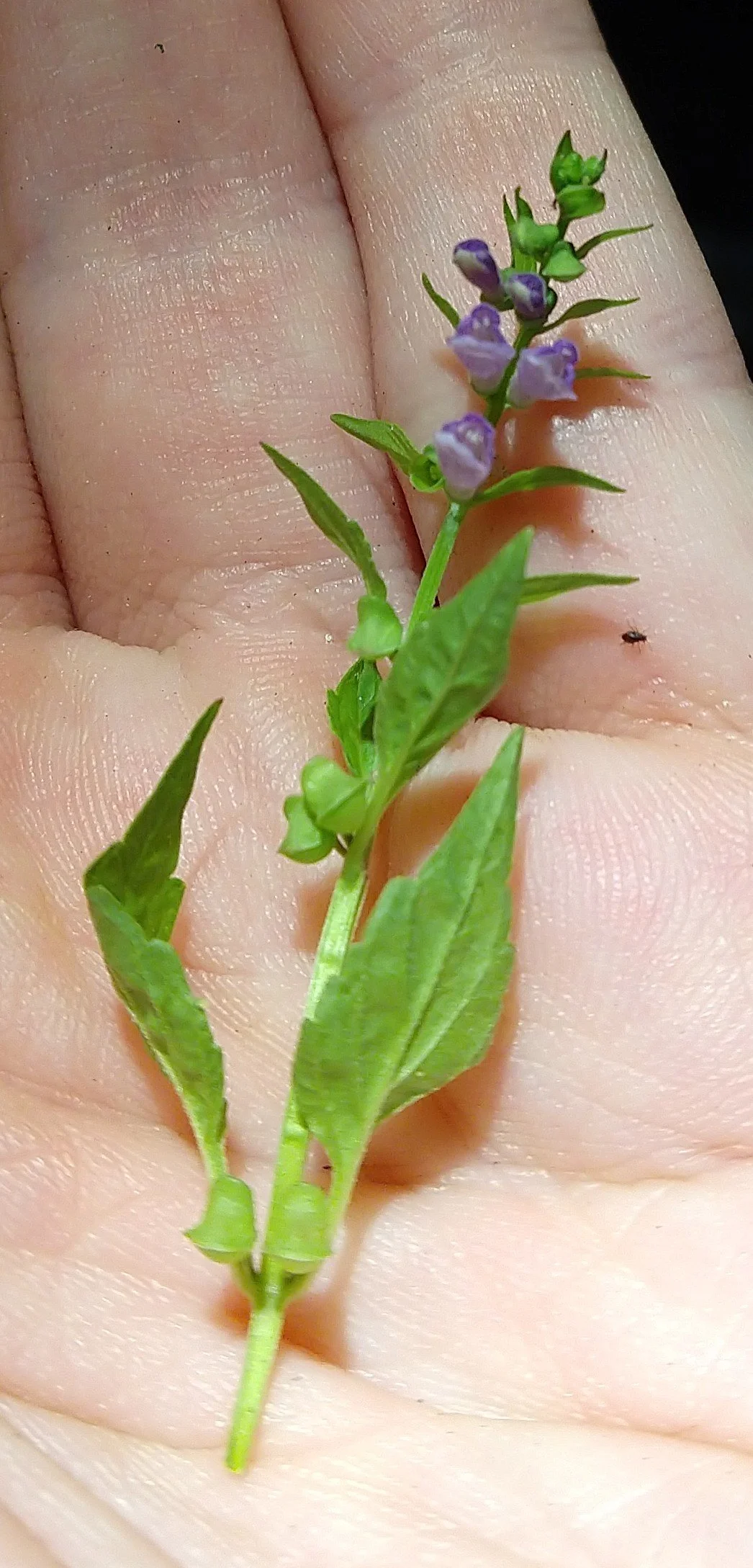
American skullcap is a perennial herb native to North America. Like many members of the mint family, it has opposite leaves and a somewhat square stem, but its flowers give it away as something a little different.
Instead of forming one large flower cluster at the top of the plant, its small flowers appear along the sides of the stems.
Look closely and you'll notice the little cap-like structure surrounding the flower.
And that's where the name comes from.
The botanical name Scutellaria comes from the Latin scutella, meaning a small dish or bowl, referring to the shape of the flower's calyx.
It's one of those delightful botanical details that makes you appreciate how many stories are hiding in plant names.
A Plant for the Overstimulated
In traditional Western herbalism, American skullcap is known as a nervine, a term traditionally used for herbs associated with the nervous system and with states of tension, restlessness, or nervous exhaustion.
But “nervine” can be an awfully clinical-sounding word for what herbalists are often describing.
Sometimes what we really mean is:
Everything is too loud.
The lights are too bright.
The sounds are too much.
The thoughts won't stop circling.
You are tired, but your mind has apparently decided this would be an excellent time to review every conversation you've had since 2007.
Skullcap has a long history of traditional use for nervous tension, restlessness, and agitation. Herbalists have especially valued it as a calming herb for times when the nervous system feels overstimulated.
At Trefoil, we think of it as an herb for smoothing the edges.
For the busy mind that has trouble finding the off-ramp.
For the person who feels especially sensitive to light, sound, smells, or other forms of sensory stimulation.
For those evenings when the body is ready for rest but the thoughts are still making laps around the track.
These are traditional herbal perspectives, not promises of a particular medical effect. Modern research on American skullcap is still relatively limited, although researchers have begun exploring its effects on mood, anxiety, and related areas. More human research is needed.
We don't think a plant needs to be presented as a miracle cure in order to be fascinating, useful, and worthy of knowing.
American Skullcap in the Garden
One of the things we love about growing our own herbs is that the plant stops being an abstract ingredient.
We know what it looks like when it first appears.
We watch it stretch upward.
We notice when the flowers arrive.
We know when it is ready.
And with skullcap, that means waiting for those little flowers.
Here in our Georgia gardens, American skullcap usually flowers in June and July.
That's when we harvest the aerial parts the leaves, stems, and flowering tops above the ground.
There is something special about harvesting an herb in flower.
The plant has reached a particular moment in its life, and we get to meet it there.
It's one of the reasons growing herbs feels so different from simply buying an ingredient.
We know what we planted.
We know where it grew.
We know when it flowered.
And we know when we decided it was ready to come into the botanical work we do.
What Does Skullcap Taste Like?
Skullcap isn't a sweet or particularly showy herb.
Its flavor is generally mild and somewhat bitter, which is one reason we especially like it as part of a larger tea or botanical formula rather than thinking of it as a culinary herb.
In a thoughtfully made blend, skullcap can quietly contribute its character without overwhelming everything around it.
That suits us just fine.
We're rather fond of herbs that don't need to be the loudest thing in the room.
A plant doesn't always have to shout to be important.
Skullcap as a Tea or Tincture
American skullcap has traditionally been prepared in several ways, including as an herbal tea and as a tincture.
Skullcap as Tea
Tea is one of the simplest ways to spend time with an herb.
Dried plant material is infused in hot water, creating a familiar, comforting preparation that naturally asks us to slow down for a few minutes.
At Trefoil, American skullcap is part of our Relax Herbal Tea, where it works alongside other herbs rather than standing alone.
This is one of our favorite ways to experience the plant: not as an isolated ingredient, but as one member of a little botanical community.
Skullcap as Tincture
Skullcap is also well suited to tincture-making.
A tincture uses alcohol, or a combination of alcohol and water, to extract constituents from the plant into a concentrated liquid preparation.
At Trefoil, we make a simple Skullcap Tincture that is included in our Dreamer's Sanctuary offering.
Tea feels a little like sitting down with the plant.
Tincture feels more like carrying a concentrated relationship with it.
Neither is inherently “better.”
They're simply different ways of working with the same botanical.
Skullcap at Trefoil Gardens
American skullcap has found its way into several corners of our botanical work.
Relax Herbal Tea
Skullcap is part of our Relax Herbal Tea, a gentle evening blend created for those moments when the day is beginning to wind down and you'd like to invite a little more quiet into the room.
Soft Landing
Skullcap is also part of Soft Landing, our botanical blend created around the transition from busy daytime energy toward evening rest.
The name really does say what we mean.
Not knocking yourself out.
Not escaping the day.
Just finding a softer place to land.
Dreamer's Sanctuary
For those who want to meet skullcap more directly, our Dreamer's Sanctuary offering includes a simple Skullcap Tincture.
Sometimes you want a blend.
Sometimes you want to know one herb.
[Explore Dreamer's Sanctuary →]
American Skullcap vs. Chinese Skullcap
“Skullcap” isn't actually one plant.
Scutellaria is a large genus containing many different species around the world.
American skullcap is Scutellaria lateriflora.
Chinese, or Baikal, skullcap is Scutellaria baicalensis.
They are different plants, with different traditional uses, different plant parts commonly used, and different bodies of research behind them.
Research on one species should not automatically be assumed to apply to the other.
This is one reason we like to use botanical names whenever we're talking seriously about herbs.
A common name can tell you where to start.
The botanical name tells you which plant you're actually talking about.
Why Growing Our Own Matters
There is another reason American skullcap is especially meaningful to us.
Commercial skullcap material has historically been subject to adulteration with plants in the Teucrium genus, commonly called germander. Some germander species contain compounds associated with liver toxicity, and researchers have developed analytical methods specifically to distinguish authentic Scutellaria lateriflora from these adulterants.
For us, this is one more reason that growing our own herbs matters.
We know what we planted.
We know where it grew.
We know when we harvested it.
We know which part of the plant we're using.
And we get to watch the whole process unfold from garden to botanical preparation.
That's a very different relationship with an herb than simply ordering “skullcap” from a supplier and putting it on a label.
It's part of what we mean when we talk about seed-to-bottle.
A Note About Safety
“Natural” doesn't automatically mean “risk-free.”
American skullcap has a long history of traditional use, but modern research on its safety and efficacy in humans remains limited.
Historical reports of liver injury have involved products labeled as skullcap, and subsequent investigation has raised concerns about adulteration or misidentification with hepatotoxic Teucrium species. Correct botanical identification therefore matters.
As with any concentrated herbal preparation, herbs can interact with medications, and the safety of many herbs during pregnancy and breastfeeding is not well established.
If you take medications, are pregnant or breastfeeding, have a medical condition, or are considering an herb for a significant health concern, talk with a qualified healthcare professional before using concentrated herbal preparations.
And if you're working with skullcap yourself, make sure you're working with the correct species.
Plants deserve names.
Names deserve accuracy.
The Trefoil Way: Know Your Plants
One of the things we love about herbalism is that it invites us to become curious again.
What's the plant called?
Where does it grow?
What does it look like?
When does it flower?
Which part do we harvest?
How has it traditionally been used?
What happens when we make it into tea?
What happens when we make a tincture?
These questions are part of what we mean when we talk about keeping plant knowledge in the community.
For us, a botanical isn't simply an ingredient on a label.
It's a plant with a name, a place, a growing season, a history, and a relationship with the people who tend it.
American skullcap is one of those plants.
Quiet, unassuming, and worth knowing.
Find American Skullcap in the Trefoil Garden
You can meet Scutellaria lateriflora in several of our botanical offerings:
Relax Herbal Tea - a gentle herbal tea blend featuring American skullcap.
Soft Landing - our botanical formula featuring skullcap alongside other herbs chosen for a softer evening wind down.
Dreamer's Sanctuary - includes our simple Skullcap Tincture for those who want to explore the herb more directly.
[Explore Trefoil Gardens Botanicals →]
A Final Thought
Maybe that's what I like most about skullcap.
It isn't a flashy plant.
It doesn't demand your attention.
It simply grows.
Then, when the time is right, it flowers.
And if we're paying attention, we harvest it.
A little later, we pour a cup of tea.
The room gets quieter.
The thoughts stop chasing one another quite so hard.
And for a few minutes, there is nothing particularly urgent to do.
Just a plant.
A cup.
A little breathing room.
Sometimes that's enough.
A Note from Trefoil Gardens
Our herbal monographs are written to share traditional herbal knowledge, our experiences growing and working with plants, and the botanical stories behind our products.
They are educational in nature and are not intended to diagnose, treat, cure, or prevent disease or to replace individualized medical advice.
Ashwagandha Root at Trefoil Gardens